
IBEW Local 350 was chartered in Hannibal, Missouri on January 28, 1903. It joined a young brotherhood of electrical workers at a time when the country was being wired for the electrical age.
The Charter
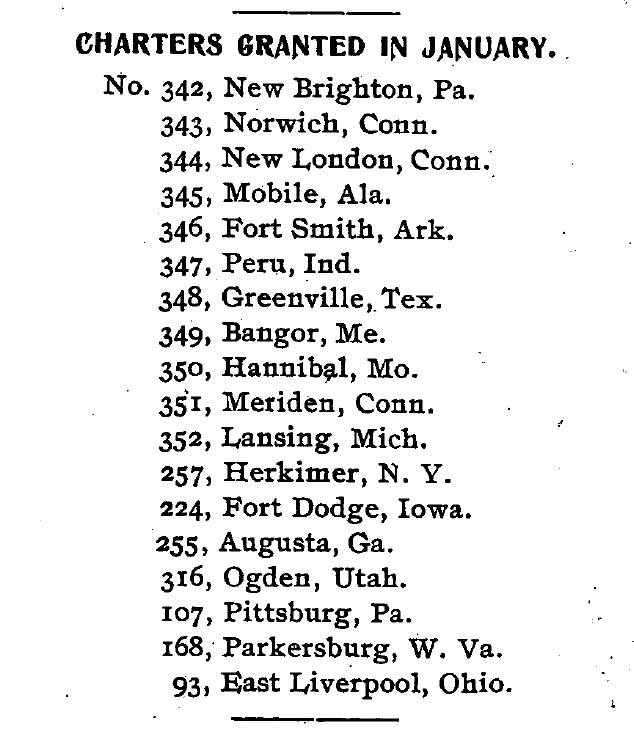
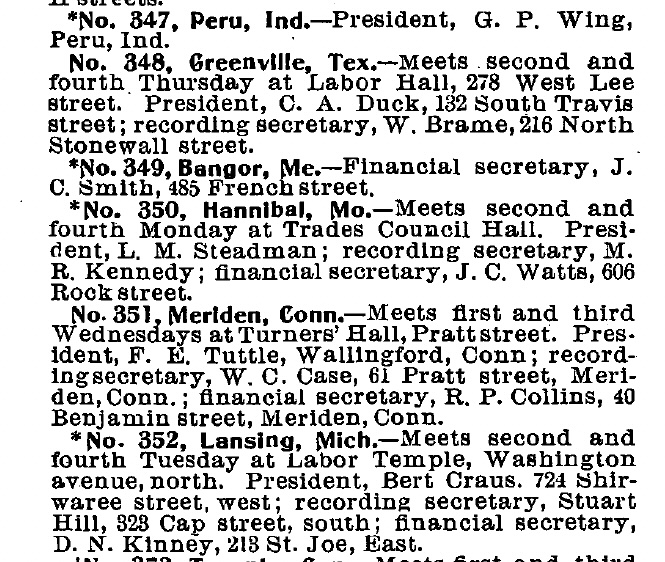
Local 350's charter was recorded in The Electrical Worker's list of new locals, "Charters Granted in January," alongside towns from Bangor, Maine to Lansing, Michigan. Number 350 was Hannibal, Missouri.
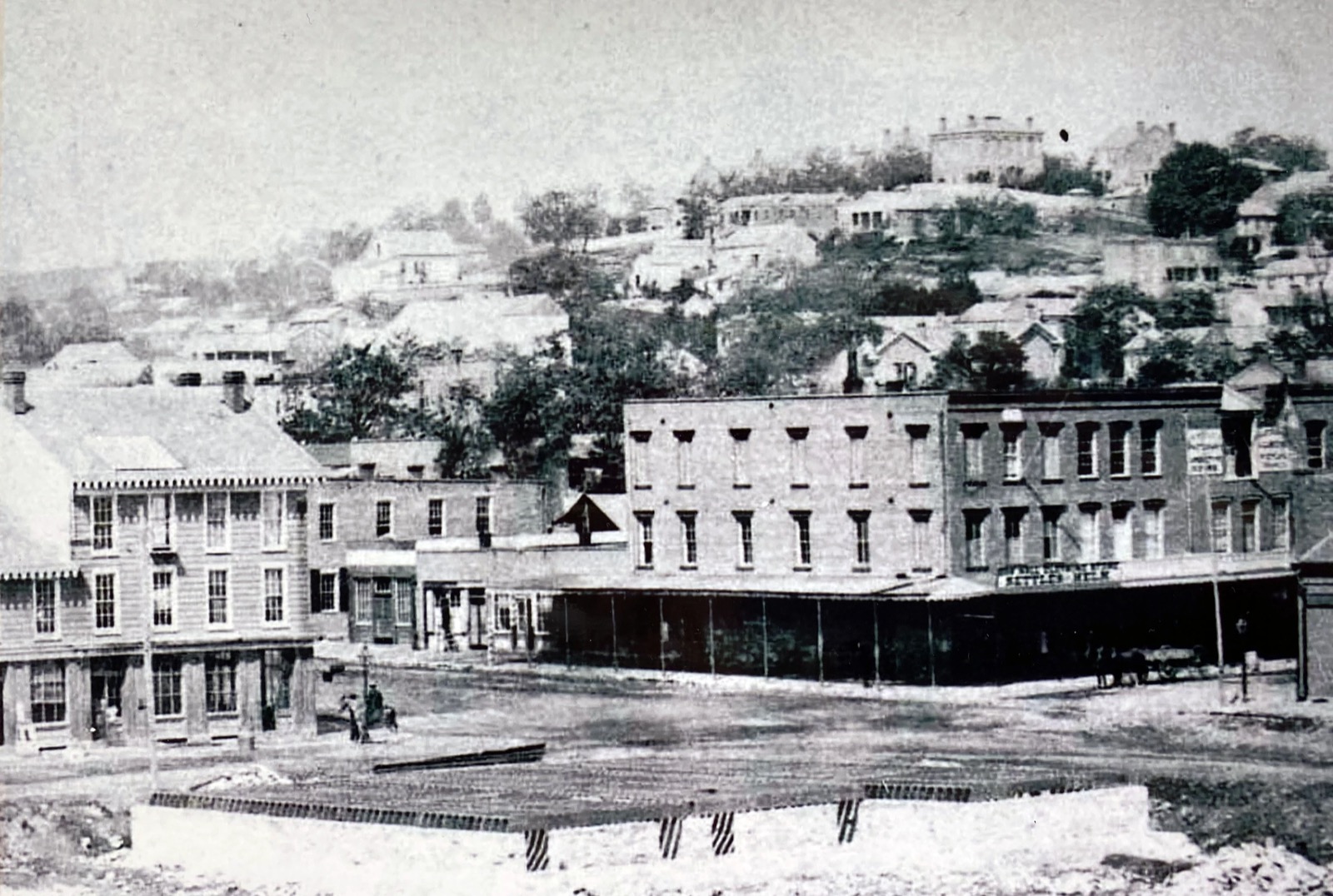
Founded at the Settles Building, February 1903
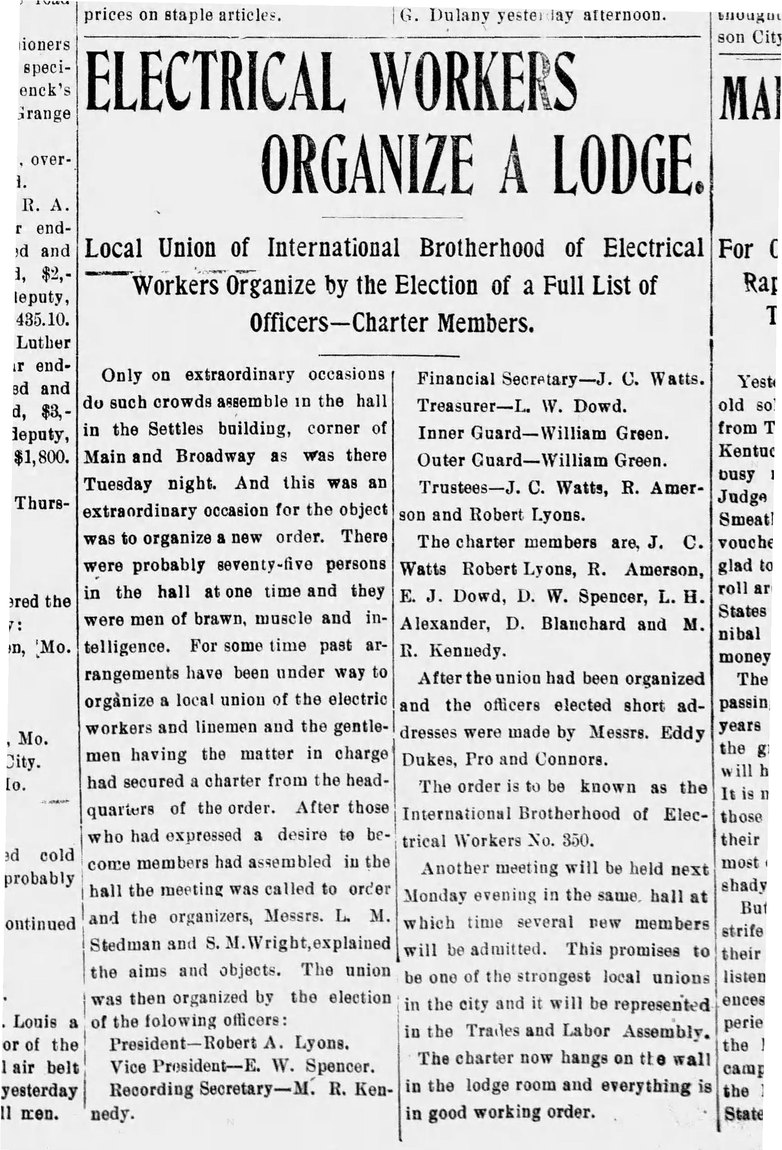
Within days of the charter, Hannibal's electrical workers gathered to organize their lodge. On the night of Tuesday, February 3, 1903, some seventy-five "men of brawn, muscle and intelligence" packed the Settles building, at the corner of Main and Broadway, to elect officers and bring Local 350 to life. The Hannibal Courier-Post noted that such crowds assemble "only on extraordinary occasions," and the founding of a new order was one of them.
The members elected their first slate of officers: Robert A. Lyons, president; E. W. Spencer, vice president; M. R. Kennedy, recording secretary; J. C. Watts, financial secretary; and L. W. Dowd, treasurer, with William Dowd and William Green standing as guards and J. C. Watts, R. Amerson and E. J. Dowd as trustees. Organizers Eddy, Dukes, Pro and Connors had secured the charter from headquarters, while L. M. Steadman and S. M. Wright "explained the aims and objects" of the order. The new lodge would be known as the International Brotherhood of Electrical Workers, No. 350.
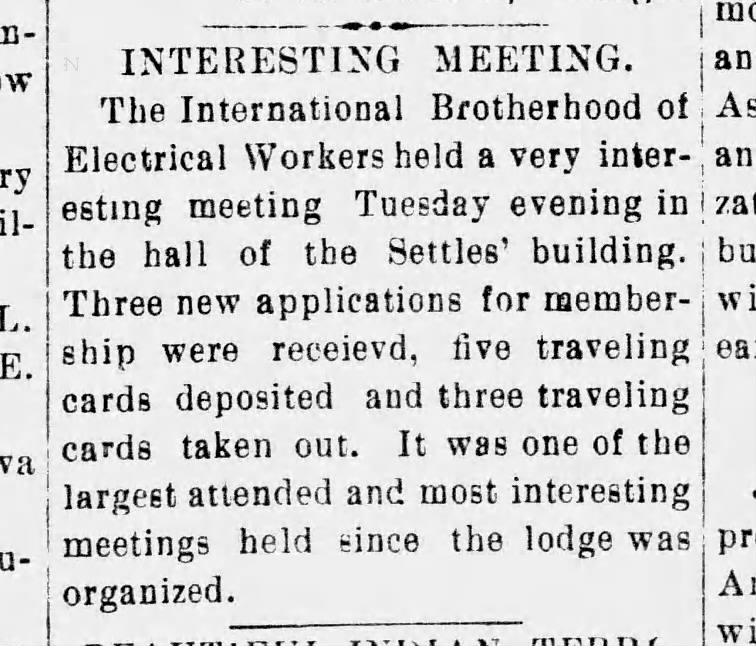
The local met again two weeks later in the same hall. The Courier-Post called it "one of the largest attended and most interesting meetings held since the lodge was organized," with three new applications for membership received and five traveling cards deposited as union electrical workers passed through town.
The Trades Council Hall & Spring Officers
By the time the brotherhood published its April 1903 directory of locals, Local 350 had settled into a regular meeting place. The listing reads: "No. 350, Hannibal, Mo. Meets second and fourth Monday at Trades Council Hall." The Trades Council Hall stood at the corner of Sixth Street and Broadway (600 Broadway) in downtown Hannibal. The same listing names the local's officers that spring: President L. M. Steadman - one of the organizers who had explained the order's aims at the founding meeting - recording secretary M. R. Kennedy, and financial secretary J. C. Watts of 606 Rock Street.
Local 350's First Words in Print
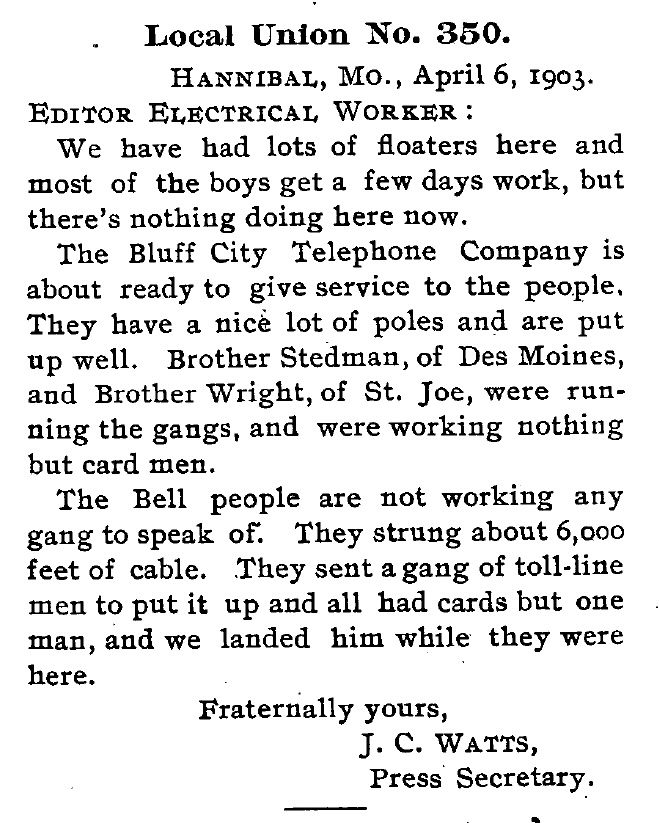
In its first letter to The Electrical Worker, press secretary J. C. Watts reported on the work around Hannibal. The Bluff City Telephone Company was stringing some 6,000 feet of cable, and the local made sure the crews were union men.
The First Strike, December 1903
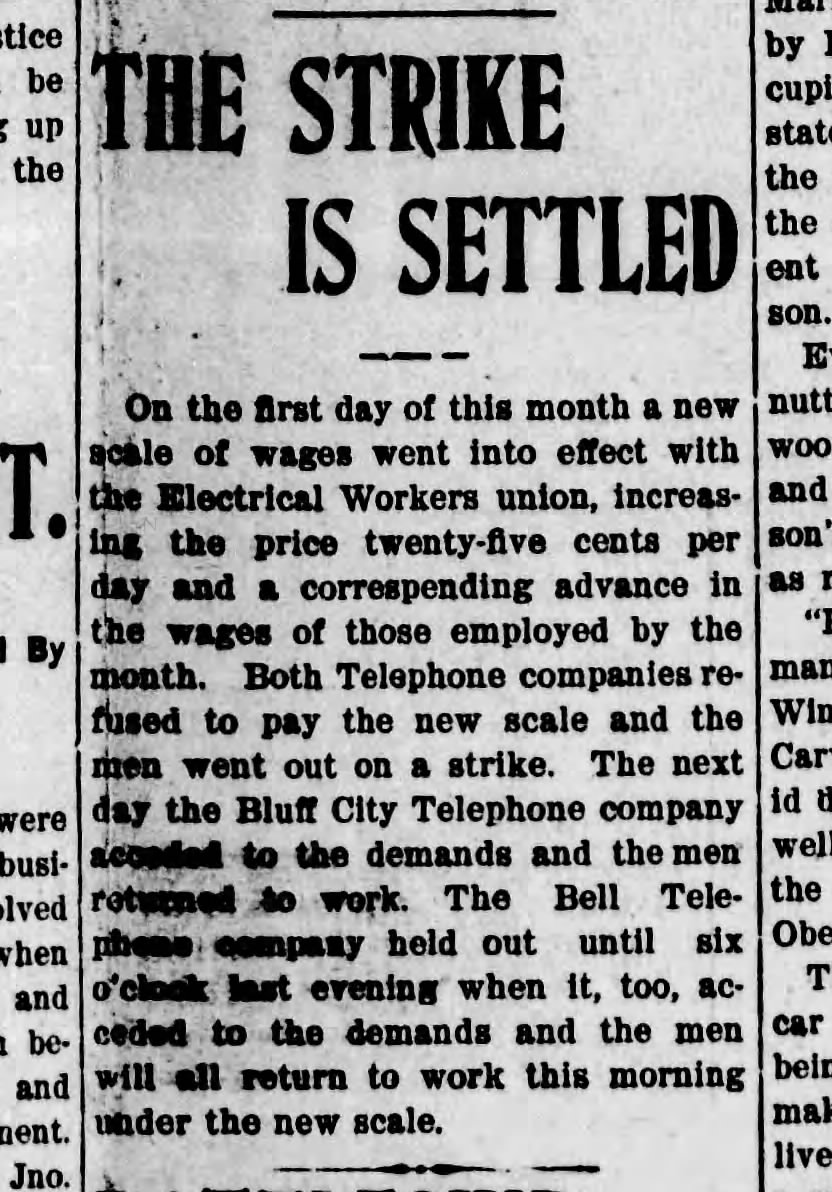
Local 350's first year ended with a show of strength. On the first of December 1903, a new wage scale took effect, raising members' pay twenty-five cents a day with a corresponding advance for those paid by the month. When both of Hannibal's telephone companies refused the new scale, the men walked out. The Bluff City Telephone Company acceded to the union's demands the very next day; the Bell Telephone Company held out until six o'clock that evening before it, too, gave in. The men returned to work under the new scale - a clean victory for the young local.
The State of the Union, 1903
When Local 350 received its charter, the International Brotherhood of Electrical Workers was barely a dozen years old, having been founded in St. Louis in 1891. The 1903 issues of The Electrical Worker read like dispatches from a movement finding its footing, with letters from locals in Pittsburgh, Detroit, Philadelphia, Minneapolis, Duluth, and even Manila. The trade was the cutting edge of its day: line work, inside wiring, telephone and telegraph, electric streetcars, and the new central-station light and power. It was dangerous, underpaid work, and the journal's pages are full of brothers laid up by falls from poles, crushed limbs, typhoid, and smallpox. Two causes ran through every issue: the eight-hour day and the union label.
The 1903 numbers also show a union maturing. Locals debated whether to move the convention from Salt Lake City to Indianapolis, weighed Socialist politics, and mounted a heartfelt campaign for an invalid and pension fund so that aged and disabled linemen would not face, as one editorial put it, "the poorhouse or a revolver." Other pages described early "current-proof safety suits" for live-wire men, jurisdiction fights with the gas fitters over conduit, and organizing drives reaching into Canada. By turns idealistic, fraternal, and militant, this was the brotherhood that Hannibal's electrical workers joined.
Hannibal & the Labor Movement, 1903
Local 350's charter came at a high-water moment for American labor. Nationally, 1903 followed close on the great 1902 anthracite coal strike. That same year, Hannibal-born Mary Kenney O'Sullivan, the daughter of Irish immigrants, helped found the National Women's Trade Union League with AFL backing.
Closer to home, Hannibal supported an active labor press, the Hannibal Labor Press, and the Atlas Portland Cement plant opened just south of the city. That plant gave rise to ILASCO, an immigrant workers' village later listed on the National Register of Historic Places, which drew Romanian, Slovak, Italian, Polish, Croatian, Hungarian, and Ukrainian laborers. It was in this climate of organizing and industrial growth that the electrical workers of Hannibal built Local 350.
Sources: The Electrical Worker (1903); Hannibal Courier-Post (February 1903); Hannibal Weekly Journal (December 1903); State Historical Society of Missouri; National Register of Historic Places (ILASCO).